
Floyd County Warrant Searches
The Floyd County Sheriff’s Office warrant page is the official starting point. It links CentralSquare and says FCSO maintains original warrants and updates GCIC and NCIC. The public portal’s coverage and update timing are not stated, so a blank search is not proof that no process exists.
Prepare the full legal name, date of birth, likely court, and any citation or case number. Speak with counsel before appearing in person because Georgia’s official guidance warns that a self-check at an office can result in custody.
- Follow the sheriff’s current Active Warrants link to CentralSquare.
- Use the identifiers the live form requests, without assuming undocumented search behavior.
- Call FCSO Warrant Division at 706-236-2466 to confirm status and the issuing court.
- Check Rome or Cave Spring Municipal Court, or Probate Court for an outside-city traffic citation.
- Use NextRequest for existing records, and contact another county’s sheriff for out-of-county process.
There is no verified Floyd warrant-specific mail, fax, drop-box, or mobile-app channel. Payment portals for citations do not prove that a warrant was recalled. If the question concerns a federal warrant, use the federal clerk or counsel rather than the county portal. Keep a dated note of each office contacted, the status given, and the next court step.
Floyd County Warrant Portal Changes
The sheriff-linked CentralSquare warrant portal is the current online route. A Zuercher link retained on the Most Wanted page showed maintenance during the September 8, 2026 review. Start from FCSO’s main warrant page instead of an old bookmark.
The live application did not yield reliable text labels for its fields, filters, sort order, pagination, export controls, or update time during research. That gap matters. Enter only what the current screen requests, and do not promise that a given name, birth-date, or warrant-number field will always be present.
The official current-inmate page provides a useful comparison without serving as the active-warrant portal.
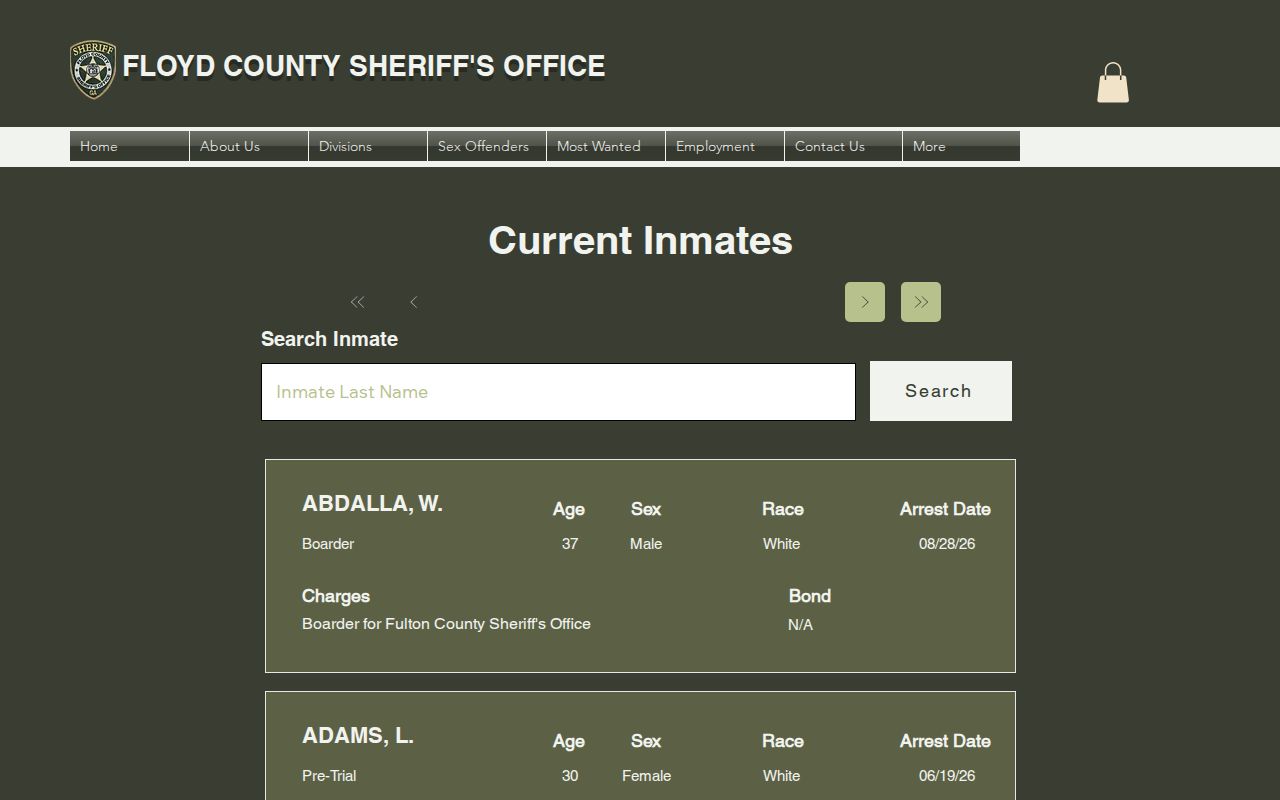
This assigned image depicts the related custody search box, which accepts an inmate last name. It must not be confused with a complete pre-arrest warrant index. Custody cards may show charges, warrant labels, issuing jurisdiction, and bond details after booking, while the active-warrant question concerns process that may not yet have been served.
What a Warrant Search Asks For
CentralSquare is dynamically rendered, and the research capture did not expose reliable field labels or required-field rules. Do not invent them. The table separates identifiers worth preparing from fields whose availability must be checked on the live form.
| Field Label | Type | Required | Notes |
|---|---|---|---|
| Full name | Identity | Verify live | Georgia guidance says to prepare it. |
| Date of birth | Date | Verify live | Helps distinguish similar names by phone. |
| Warrant number | Identifier | Verify live | Local code formats were not decoded. |
| Court | Jurisdiction | Verify live | Municipal and federal coverage is not established. |
Use the court or agency named on any hit to resolve identity conflicts. A shared name is not enough. Ask the office to compare date of birth and the record identifier, then confirm whether the displayed status is current. Never decode a Floyd identifier from its letters or digits because no official public code legend was located.
Floyd County Warrant Phone Confirmation
The direct Warrant Division number is 706-236-2466. The sheriff’s FAQ also routes warrant and protective-order service questions through 706-291-4111 extension 8823. Booking and release questions use a different extension, 8834.
The official FAQ capture preserves that service-status distinction without displaying private records.
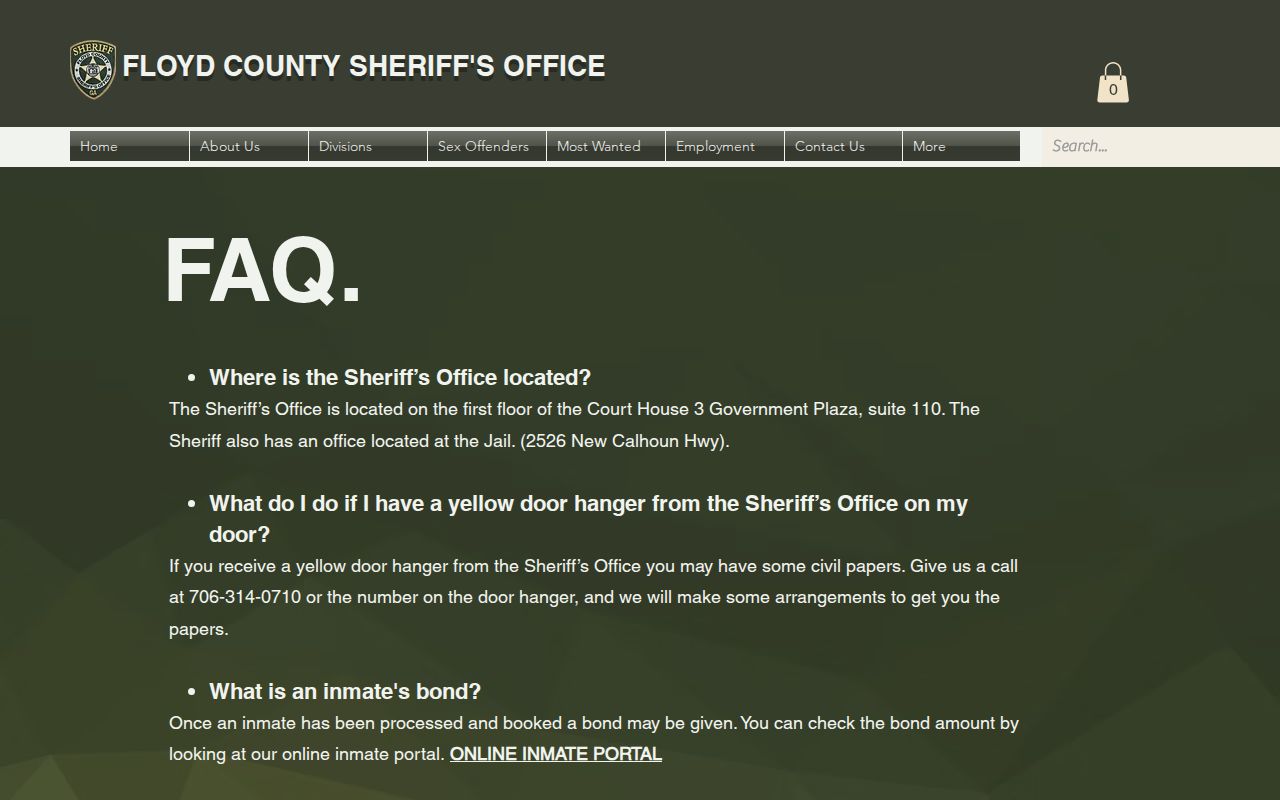
Ask for the responsible court, the status timestamp, and whether an in-person appearance can lead to custody.
The FCSO contact page also distinguishes public contact from the county's formal records route.
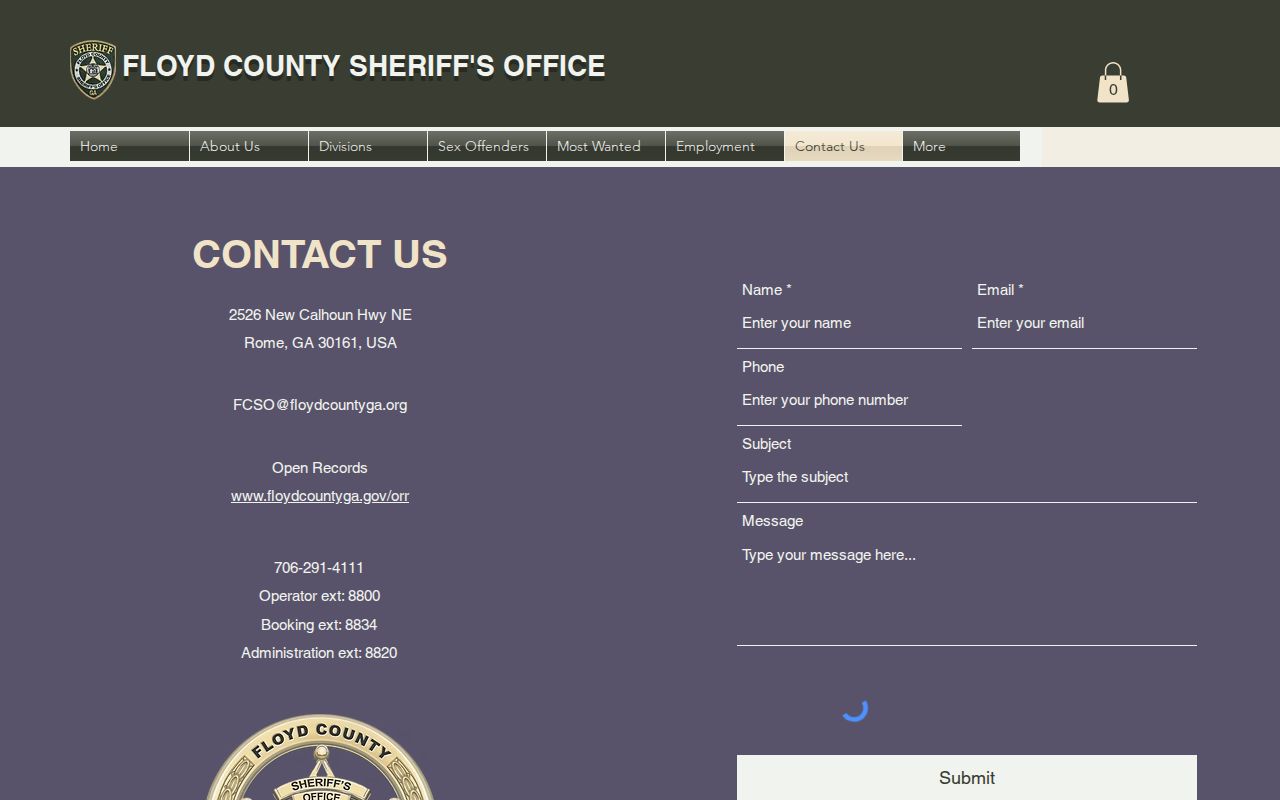
Use that general contact channel for routing, but use NextRequest when requesting an existing county record.
Floyd County Warrant Search Results
The sheriff’s custody interface shows the kinds of details that can accompany a warrant-related booking, but it is not the active-warrant schema. A search hit should be read as a point-in-time public record and checked against the original warrant or court file.
| Warrant Number | Agency identifier, such as synthetic 26CW0000; no code meaning is claimed. |
|---|---|
| Charge / Offense | Allegation and possible O.C.G.A. citation, not guilt. |
| Issuing Court | The office that controls the next court step. |
| Bond Amount | Amount, type, or no-bond display requiring confirmation. |
| Status | Active, served, recalled, or disposed at a stated time. |
Separate allegation from outcome. A charge label describes the claim tied to the process, while a disposition records what later happened in court. Likewise, a bond field does not promise immediate release or show that a judge will allow the same terms today. Save the result privately, note the time, and call the issuing office for the current status.
When a Floyd County Warrant Check Is Empty
Do not treat an empty screen as an all-clear. A warrant may be newly issued, sealed, juvenile, federal, held by a municipal court, or omitted from the public subset. Portal downtime and indexing lag can also affect what appears. FCSO does not publish a completeness promise or update cadence on the reviewed warrant page.
Confirm with FCSO and the likely court. If the concern follows a Rome court date, call Rome Municipal Court. For Cave Spring, contact its Municipal Court clerk. Outside-city traffic matters belong with Probate Court. A current-inmate search answers only whether a person appears in that custody interface.
A conflicting answer also needs human review. Preserve the portal date and wording, give the issuing clerk the warrant or case number if known, and ask whether the process was served, recalled, or disposed. Portal absence and court disposition are different facts.
Floyd County Warrants: Who Holds What
FCSO is the main county custodian. Magistrate Court handles warrant applications, first appearances, bonds, and preliminary hearings. Rome and Cave Spring Municipal Courts control their city matters, while Probate Court handles traffic citations issued outside city limits. The Northern District’s Rome Division controls federal dockets.
Georgia's official warrant guidance confirms there is no single public statewide warrant database. GCIC and NCIC are operational systems, not a public name-search substitute. For another Georgia county, contact its local sheriff.
The office that holds the record may differ from the office that serves it. Ask which court issued the warrant, which agency has service responsibility, and which clerk can confirm a recall or disposition. That three-part check avoids treating a police record, court docket, and sheriff entry as the same document.
Floyd County Warrant Records Requests
NextRequest is useful for an existing warrant record, service log, disposition, or policy. It is not an instant status checker. Under O.C.G.A. § 50-18-71, an agency generally need not create a new compilation to answer a broad question. Narrow the request by office, record type, date range, and known identifier. Ask for non-exempt portions if part of the file is withheld.
The official county request landing identifies the County Clerk as records custodian.
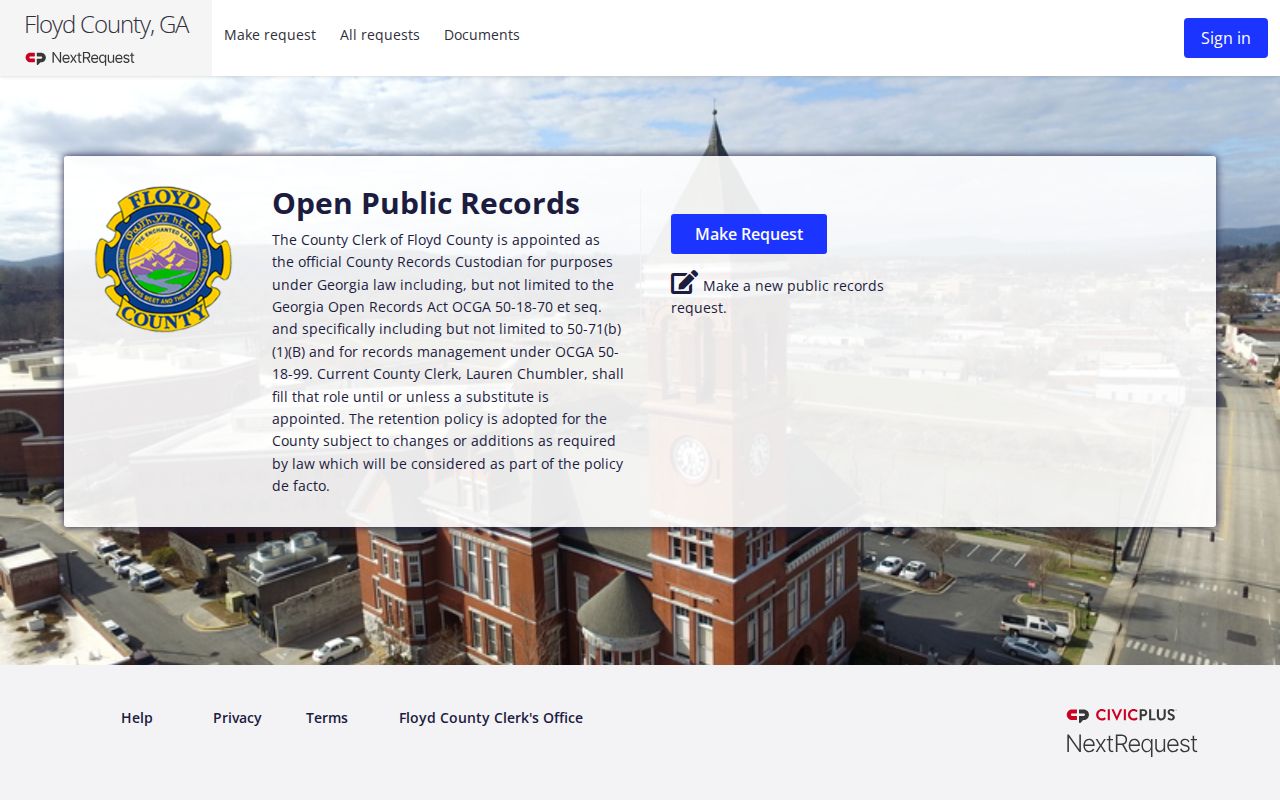
The request control is a document-access route. Operational clearance still comes from the issuing court or sheriff. A municipal record may require the city custodian instead. A delayed response, redaction, or no-record answer does not by itself establish that no warrant exists.
Floyd County Warrant Status Terms
Short labels can conceal distinct legal events. Confirm the office’s meaning rather than decoding an identifier by guesswork.
- Active
- Operational status at the time an agency confirms it.
- Served
- Process has been executed or returned as the official record states.
- Recalled or quashed
- The issuing court withdrew the warrant through an order.
- Disposition
- The later court event, which may differ from a portal status.
- FTA
- Failure to appear, sometimes linked to a bench warrant and traffic consequences.
For a traffic FTA, ask both the court and Georgia DDS what remains. A court payment, warrant recall, and license reinstatement can be separate steps. Keep the receipt, recall order, and proof that the court transmitted any required clearance. Do not assume a portal refresh occurs at once.
Which Warrants Stay Restricted
The Georgia Open Records Act supports access to existing non-exempt records. It does not override sealed orders, juvenile confidentiality, or specified law-enforcement exemptions. A request should describe an existing record and ask for segregable public portions.
Key Rules:
Sealed process is not available through ordinary public channels.
Juvenile records may remain confidential under O.C.G.A. §§ 15-11-58 and 15-11-59.
Investigative material may be withheld under O.C.G.A. § 50-18-72; absence is not proof that no warrant exists.
Restrictions protect records for specific legal reasons; they do not invite a conclusion about the underlying person or case. When access is denied, request the cited exemption and any portion that can lawfully be separated. For a self-check involving restricted process, counsel and the issuing court are safer sources than repeated public searches.