
Floyd County Warrant Checks
The Floyd County Sheriff's Office warrant page is the official first stop. It links to the public Active Warrants portal. It also names the Warrant Division as the unit that keeps original warrants and updates entries in GCIC and NCIC. Have your details ready before a Floyd County warrant check: full legal name, date of birth, and any citation, case, or warrant number. A shared name can muddy the results. Confirm an online match with a person rather than trusting the screen. One search still cannot answer everything. A Rome or Cave Spring municipal matter stays with that city court. A traffic citation written outside the city belongs to Floyd County Probate Court. Court files supply the case history, while the sheriff handles service and warrant custody. Georgia's official existing-warrant guidance confirms no single public statewide warrant search exists, so the local agency and the issuing court remain the key sources. The sheriff also offers no warrant-clearing app and no warrant-specific mail, fax, or drop-box route. A citation payment service is not a clearing channel either.
- Open the sheriff's official warrant page and follow its current Active Warrants link. Record the date and exact wording of any result.
- Use the identifying details the live portal requests. Its controls can change, so never infer a field that is not displayed.
- Contact Rome Municipal Court, Cave Spring Municipal Court, or Probate Court when the issue began as a city or county traffic citation.
- Call the Warrant Division at 706-236-2466 or submit a narrow Floyd County records request when a portal result is unclear.
- If a warrant may be active, speak with a Georgia criminal-defense attorney before appearing in person or trying to resolve it.
Floyd County Warrant Division Route
FCSO draws a line between a web lookup and human confirmation. The Warrant Division takes calls at 706-236-2466 on weekdays. Hours run 8:00 a.m. to 7:00 p.m. Call ahead before traveling. The sheriff's FAQ also routes questions about warrant or temporary-protective-order service status to extension 8823. That is a service question only. It does not tell you whether a Floyd County warrant exists or whether someone has been booked. The sheriff's warrant page shows where the Active Warrants link and Warrant Division contact sit. That official page carries public office information, not a warrant roster or identifying data.
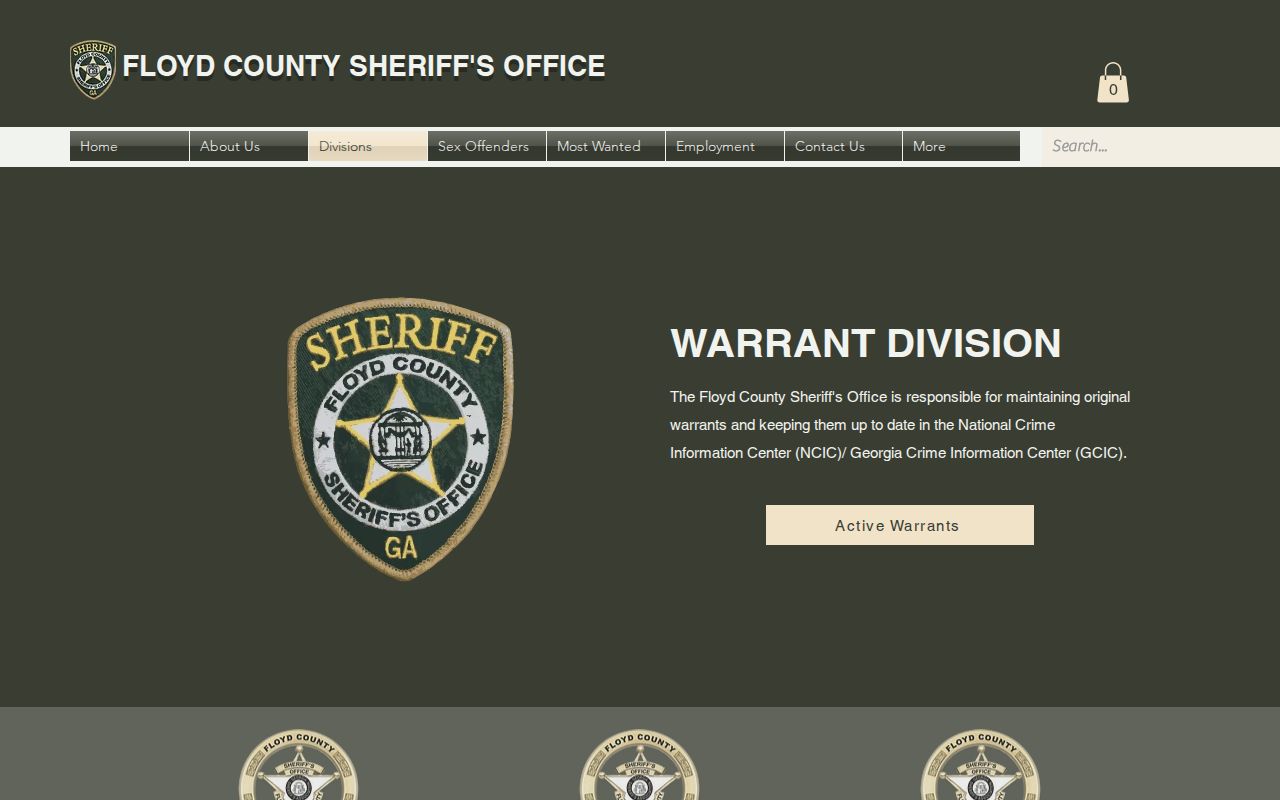
Agencies can replace a vendor address without notice. Use the linked source as your launch point. If a saved bookmark behaves oddly, go back to the FCSO warrant page and confirm the current route for a Floyd County warrant search.
Warrants in Floyd County: The Main Types
The label on a Floyd County warrant tells you why it arose and which court controls what happens next. An arrest warrant usually follows a sworn complaint. It can also rest on a law-enforcement application backed by probable cause. A bench warrant follows a missed court date. A search warrant authorizes a search for evidence and is distinct from process that authorizes an arrest. Capias is custody-process language. Floyd County publishes no single glossary of these terms, so the issuing record controls.
| Warrant Type | How It Arises | Who Issues It |
|---|---|---|
| Arrest warrant | A complaint or affidavit supports a request to arrest a named person. | A magistrate or other authorized judicial officer |
| Bench warrant | A person misses court or does not comply with an order. | The judge handling the case |
| Search warrant | An application seeks authority to search a place or item for evidence. | An authorized judicial officer |
| Capias or FTA process | A court directs custody after a missed appearance or unresolved court obligation. | The court controlling the underlying matter |
Floyd County Magistrate Court plainly spells out its warrant work. It covers civilian warrant applications, arrest and search warrant execution, first appearances, bond hearings, and preliminary hearings. City judges handle their own process. A warrant's title alone never reveals its current status, bond, or final disposition.
Floyd County Warrant Portal Limits
The FCSO Active Warrants link currently points to a CentralSquare web application. The app publishes no field labels, filters, or sort controls. It shows no update time or completeness statement either. A field-by-field tutorial would overstate what a visitor can actually see on a live screen. Follow whatever labels the screen gives you. Enter nothing beyond what the official form asks for. The sheriff's warrant page itself shows the FCSO-linked portal shell, with no result rows or personal data. Treat that as orientation for a Floyd County warrant lookup, not a promise the interface never changes.
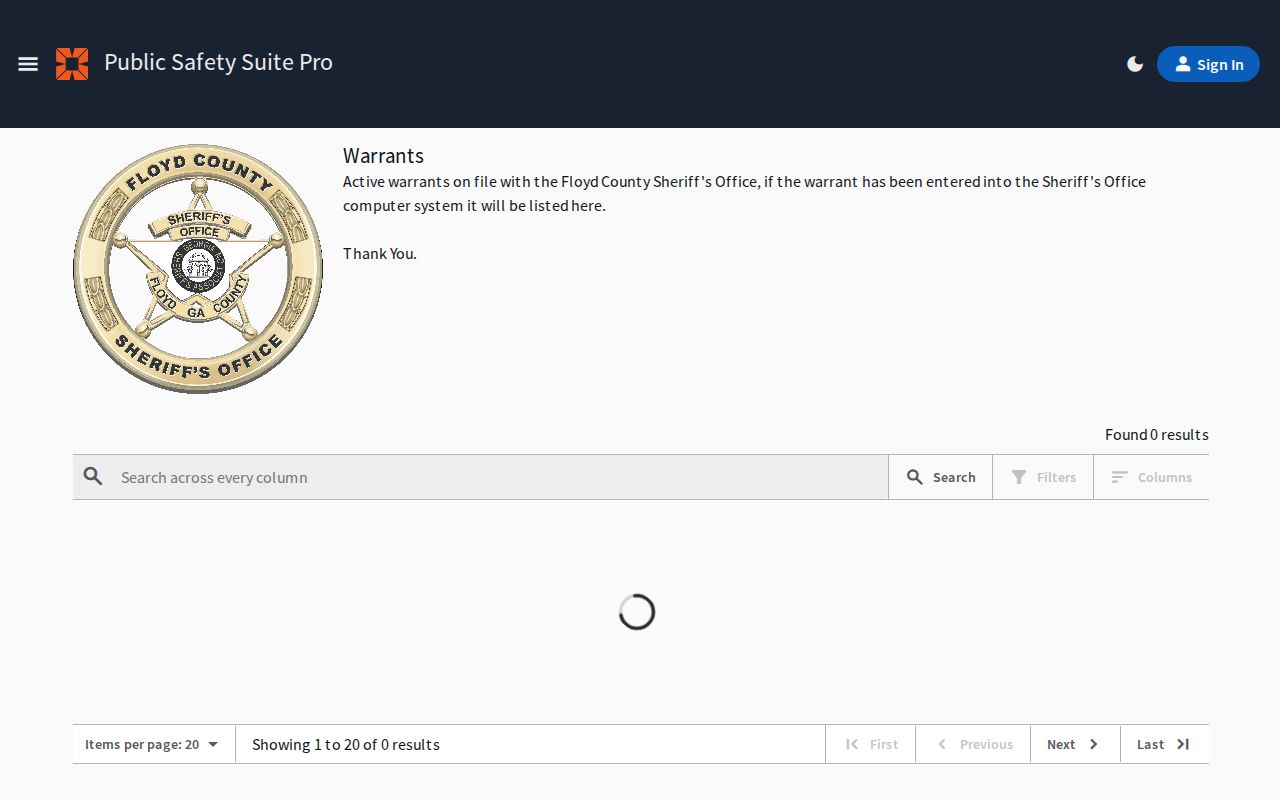
A former Zuercher link still sits on the sheriff's Most Wanted page. It displays maintenance mode. Treat CentralSquare as the online channel FCSO currently links for Floyd County, and confirm with the sheriff if it fails to load.
| Search Element | Verified? | How to Handle It |
|---|---|---|
| Official launch link | Yes | Enter through the FCSO warrant page. |
| Name or DOB fields | Not captured | Use only the controls currently displayed. |
| Coverage and update time | Not published in reviewed text | Ask the Warrant Division before relying on a result. |
| Export or payment tools | Not verified | Do not assume either function exists. |
Floyd County Warrant Records: What They Show
A public warrant display, a court file, and a custody card are three different animals. FCSO current-inmate cards carry plenty: age, sex, race, arrest date, custody class, charges, code descriptions, a warrant type and identifier, issuing jurisdiction, and bond information. Those are custody-side fields. They do not map onto every pre-arrest warrant record. Nor do they prove a public list covers every municipal, sealed, juvenile, federal, or newly issued warrant in Floyd County. Ask the clerk for what the roster leaves out.
| Warrant Number | An agency or court identifier, such as a masked example 26CW####. Floyd code meanings were not verified and should not be guessed. |
|---|---|
| Subject Name | The name attached to the record; confirm identity with date of birth or the responsible office. |
| Charge or Offense | The alleged offense or underlying citation, not a finding of guilt. |
| Issuing Court | The court or judicial officer that authorized the process and often controls recall or disposition. |
| Bond | An amount, type, or no-bond display. Status must be confirmed with the court or jail. |
| Status | A point-in-time label such as active, served, or recalled. Ask what the local code means and when it was updated. |
A warrant number is not a case result. When the outcome matters in Floyd County, get the court disposition, recall order, service return, or other source record from the clerk.
Floyd County Warrant Results and Clearance
A blank Floyd County warrant search settles nothing. The sheriff publishes no completeness promise and no update schedule for its warrant records. A case can sit in a city court instead. It may be restricted, freshly issued, filed outside Floyd County, or simply shown differently in the live system. GCIC and NCIC are law-enforcement systems that FCSO references; neither is an open public website that replaces local confirmation. So when nothing turns up, work backward to the originating event. A missed Rome court date points to Rome Municipal Court. A Cave Spring citation belongs with its municipal clerk. A traffic ticket written outside city limits goes through Probate Court, while a county criminal warrant question starts with FCSO. Federal process belongs to the Northern District of Georgia and federal agencies, not a county portal.
Note: Keep a dated copy or confirmation of your warrant result for your files, but never post a name, charge, or other identifying detail publicly.
Floyd County Warrants: Who Issues, Who Serves
Judges issue warrants; officers serve them. In Floyd County, Magistrate Court takes warrant applications and holds judicial hearings, while Superior Court controls felony and other general-jurisdiction cases in the Rome Circuit. Rome Municipal Court can issue warrants for matters inside Rome city limits. Cave Spring's municipal court runs its own city citation and court process. Probate Court handles traffic citations issued outside city limits. FCSO says it maintains the original warrants and updates GCIC and NCIC. The originating or serving agency could just as easily be Floyd County Police, Rome Police, Cave Spring Police, the Georgia Bureau of Investigation, or Georgia State Patrol. Issuing court, record holder, and serving officer may all be different offices.
FCSO Warrant Division
2526 New Calhoun Highway
Rome, GA 30161
706-236-2466
The practical flow is: application or missed court event → judicial review → warrant issuance → agency entry and service → court-directed recall, return, or disposition.
Floyd County Warrant Court Map
Three Floyd County addresses get confused constantly. County courts sit at 3 Government Plaza; the Superior Court Clerk's office is in Suite 101, and the sheriff's courthouse office is listed in Suite 110. The jail and bonding lobby are at 2526 New Calhoun Highway. Rome Municipal Court and Rome Police share 375 Technology Parkway. Call first so you land at the right counter and can ask about custody risk before you go.
| Origin of Matter | First Office | What to Confirm |
|---|---|---|
| County criminal warrant | FCSO Warrant Division | Existence, service route, issuing court, and whether in-person contact may lead to custody |
| Rome citation or ordinance case | Rome Municipal Court | Appearance status, warrant status, and whether payment is permitted |
| Cave Spring citation | Cave Spring Municipal Court or City Hall | Court date, appearance duty, payment eligibility, and recall steps |
| Outside-city traffic ticket | Floyd County Probate Court | Citation status, Tuesday or Thursday court setting, and any FTA action |
Handling a Floyd County Warrant
First, confirm which court issued the warrant and its current status. Ask whether it is still active, has been served, was recalled, or was otherwise disposed. A Georgia criminal-defense attorney can tell you whether an appearance, voluntary surrender, bond request, or motion to recall or quash fits your situation. Recall and quash simply mean the court withdraws the process. Floyd County publishes no countywide fillable recall form and sets no universal deadline, so the issuing clerk or your counsel has to identify the right filing. Never assume paying a fine clears an outstanding warrant. Rome states plainly that mandatory appearances cannot be paid online. Cave Spring and Probate Court do offer citation payment paths, yet neither promises that payment alone recalls a bench warrant. Ask whether appearance is required, whether a separate order is needed, and when the update will reach agency systems. Keep every receipt and court order.
Important: Consult counsel and call the responsible office before appearing. An active warrant may lead to custody, and bond is not guaranteed.
Floyd County Warrant Bond Questions
Bond is its own question, separate from whether a Floyd County warrant even exists. A portal or custody entry might show an amount, a bond type, or no bond at all. Only the court and jail can say what is allowed right now. FCSO identifies a bonding lobby at the Floyd County Jail that runs around the clock, closing daily from noon to 1:00 p.m. for lunch, so confirm that schedule before you drive over. The current sheriff bonding page states that a cash bond requires the exact amount plus a $20 service charge. It also describes property-bond conditions and approved commercial bondsmen. An older official procedure PDF covers property, cash, bondsman, and transfer bonds and requires picture identification at the rear jail bonding lobby. That PDF may predate the current HTML guidance, so ask staff which rule controls today. Before any planned surrender in Floyd County, ask where booking happens, what identification to bring, whether a judge is available, whether transport is involved, and how bond eligibility gets decided. A clerk can give routing information but cannot give legal advice.
Warrant Record Access Under Georgia Law
Georgia's Open Records Act generally opens existing public records unless an exemption applies. Floyd County routes formal written requests through NextRequest, which names the County Clerk as records custodian. Describe one specific existing record: the office, a date range, and any known identifier. The Act does not make an agency build a new report or compile an all-clear database. Law-enforcement exemptions can shield active investigative material, confidential sources, intelligence, or other restricted content, and juvenile court and juvenile law-enforcement records follow their own confidentiality rules. Ask for the non-exempt portions and the legal basis for each withholding. An open-records response still is not operational warrant clearance.
Key Rules:
O.C.G.A. § 50-18-70 establishes Georgia's general policy of access to public records, subject to lawful exceptions.
O.C.G.A. § 50-18-71 governs requests and does not generally require a new report, analysis, or compilation.
O.C.G.A. §§ 15-11-58 and 15-11-59 form part of the confidentiality framework for juvenile court and law-enforcement records.
O.C.G.A. §§ 17-4-40 and 17-4-41 provide Georgia arrest-warrant procedure context; current code text controls.
Floyd County Warrant Records Requests
NextRequest is Floyd County's channel for written records requests. It is not a live warrant-status hotline. It works best for a document a county office already holds: a warrant, a service return, a policy, or a log. Name the likely office in your request. Give a narrow date range and describe the document you believe exists. Floyd County can decline a request for a new combined warrant list under its no-new-compilation rule. Fees vary by record. The Magistrate Court fee page, effective July 1, 2024, lists warrant-application service lines of $20 and $50 without making their exact mapping clear. Copies run $1. Certified copies cost $2.50, and exemplified copies cost $5. Those figures are court fee entries, not the price of a portal warrant search. Ask which line applies before you pay. For a municipal record, route the request to the city custodian rather than the county. And when the question is an active warrant or a safe surrender, call the Warrant Division, the issuing court, or counsel instead of waiting on an open-records response.
Floyd County Warrant Status Terms
Short labels answer different questions. Floyd County records may use one term where another office means something else, and mixing them sends you to the wrong desk. Confirm the timestamp and the agency behind each status.
- Active
- The agency or court displays the process as operational at the time checked.
- Served
- An agency records that the process was carried out; it does not state the final case result.
- Recalled or quashed
- The issuing court has withdrawn the process through a court action.
- FTA
- Failure to appear. It may prompt a bench warrant and, for traffic matters, a separate DDS consequence.
- No bond
- The custody entry does not show a bond available under that entry. The court or jail must explain its current effect.
- Disposition
- The recorded outcome or event, such as dismissal, adjudication, service, recall, or another court action.
Do not assume "Expired" means a warrant is gone. Floyd County sets no automatic end date, so confirm recall or service with the issuing court.
Floyd County Warrant Program Context
The FCSO Most Wanted page is a curated public-information program, not a complete active-warrant database for Floyd County. Many outstanding warrants never appear there, and the roster itself carries a warning about what a listing does and does not establish. Inclusion tells you nothing about warrant status, and neither does absence. Someone checking on their own name should use the warrant channel and the issuing court rather than read meaning into this selected list. The official page explains the program and its purpose.
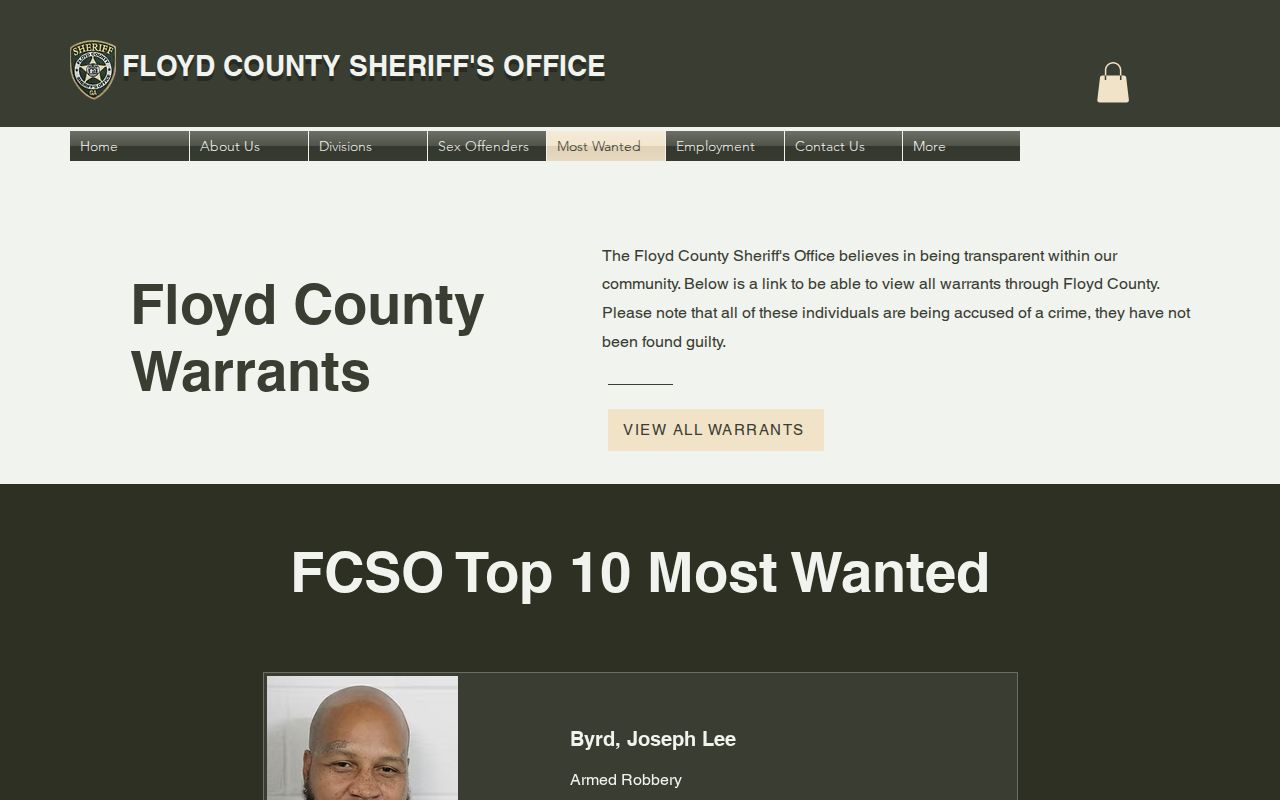
Call 911 if someone poses an immediate threat. Send tips through the official agency contact named on the current program page. Do not approach a person listed in Floyd County.
City Warrant Records in Floyd County
Floyd County holds two incorporated cities. The Northwest Georgia Regional Commission names them: Rome and Cave Spring. Each runs a municipal court. Those courts handle city matters such as traffic and ordinance cases and failures to appear. The FCSO stays the main county warrant custodian. Rome, the county seat, counted 37,713 residents in the 2020 Census. Cave Spring shows 1,174 in Census TIGERweb, and its city page rounds the 2020 figure to 1,200. A city payment site is not a warrant search. Rome says mandatory appearances cannot be paid online. Cave Spring's nCourt flow searches citations. It carries no warrant-status field, and it warns that a new citation may take up to five days to appear. For a missed city date, call the municipal court; use FCSO when the matter is countywide or the court sends it there.
Rome Warrant Records
37,713 residents in 2020 · Rome Police and Rome Municipal Court handle city-limit matters at Technology Parkway.
Cave Spring Warrant Records
1,174 residents in 2020 · The municipal court and City Hall are the documented city citation and court-status route.